
AI Phishing URL Analysis Service
AI Phishing URL Analysis Service
As of May 2026, AI Phishing URL Analysis Service has — users in the Privacy & Security category.
Usersno change0%
—
—
Ratingno change0%
—
— reviews
Reviewsno change0%
—
Version
0.0.2
Manifest V3
History
2 snapshotsTracking since Apr 29, 2026.
Not enough history yet for this metric — the chart fills in as we collect more snapshots.
View as table
| Date | Users | Rating | Reviews | Version |
|---|---|---|---|---|
| Apr 29, 2026 | — | — | — | 0.0.2 |
| May 26, 2026 | 2 | — | — | 0.0.2 |
| Now | — | — | — | 0.0.2 |
Permissions & access
- Permissions
- None declared
- Host access
- None declared
Screenshots
About
- Overview

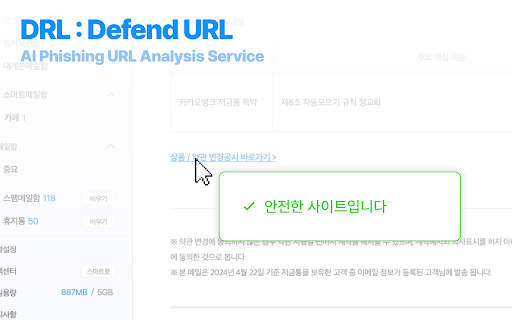
 Based on the model learned by analyzing the URL of the phishing site, it is intended to read whether the URL is malicious with AI and prevent users from accessing the phishing site in advance.

- Background

 Phishing sites have been sophisticated in recent years. The security contact company "AAG IT Service" announced that an average of 140,000 phishing sites were created every month. The surge in phishing sites is stealing personal information and assets from users of the Internet environment. In fact, according to the tally of cybercrime damages reported to the FBI's Internet Crime Reporting Center, there were more than 800,000 reported cases in 2023, totaling $10.3 billion.

 Universal phishing sites steal the user's account information by imitating the login page of a bank or financial institution, or by imitating a global logistics company, and withdraw or remit the user's money through this. In addition, a program is installed when accessed to disseminate malicious code to search for programs with sensitive personal information of users and collect information.

- Service Introduction

We increase the efficiency of URL detection of phishing sites by introducing a BERT-based approach. Based on the Kaggle, Github, and ISCX 2016 datasets, we analyze not only URL strings but also derived features.

Through this, it aims to flexibly cope with various domains by overcoming the limitations of existing problems such as data formats and domains, and to increase the defense effect against real-time cyberattacks.
Technical
- Version
- 0.0.2
- Manifest
- V3
- Size
- 112KiB
- Min Chrome
- 88
- Languages
- 1
- Featured
- No
Metadata
- ID
- nbmbeigkfdkioffdhecngbkhkglfhhfm
- Developer ID
- uc594f7255d0d9f5252a4c8f0ae849b95
- Developer Email
- [email protected]
- Created
- Jun 19, 2024
- Last Updated (Store)
- Dec 27, 2024
- Last Scraped
- May 26, 2026
- Website
- —
- Support URL
- https://www.defend-url.site
Similar extensions
Alternatives to AI Phishing URL Analysis Service, ranked by description similarity.

URL Phishing Detector
Detect phishing URLs with AI-powered analysis
—

GenXProtector
Analyze the safety of links using GenAI
2

URLGuard - AI-Powered Phishing Protection
AI-powered URL security monitoring and phishing detection
—

Criminal IP: AI-based Phishing Link Checker
A web browsing guard against malicious, scam, or phishing websites based on AI.
5.0K
★ 4.8

Phishing Detection Extension
Detects phishing websites using machine learning.
18

PhishGuard
Scans websites and emails for phishing links.
2

PhishPatrol - LLM powered Guardian
PhishPatrol is a real-time phishing detection Chrome extension that leverages a lightweight, on-device AI model to protect users…
4
★ 5.0

PhiLNet Vanguard
Detect phishing websites in real-time via secure backend API.
—
Data sourced from the Chrome Web Store · last verified May 26, 2026.