
FACTAA
FACTAA — verifies DOI, arXiv, PMID citations in LLM-generated references
As of June 2026, FACTAA has 259 users and a 5.00/5 rating from 2 reviews in the Education category.
Usersno change0%
259
259
Ratingno change0%
5.00
2 reviews
Reviewsno change0%
2
Version
1.1.0
Manifest V3
90-day change · In the last 90 days this extension 1 version update.
History
9 snapshotsTracking since Apr 23, 2026.
View as table
| Date | Users | Rating | Reviews | Version |
|---|---|---|---|---|
| Apr 23, 2026 | — | — | — | 1.0.0 |
| Apr 28, 2026 | — | — | — | 1.0.0 |
| May 5, 2026 | 135 | 5.00 | 1 | 1.0.0 |
| May 11, 2026 | 251 | 5.00 | 1 | 1.0.0 |
| May 16, 2026 | 276 | 5.00 | 2 | 1.0.0 |
| May 22, 2026 | 295 | 5.00 | 2 | 1.0.0 |
| May 29, 2026 | 308 | 5.00 | 2 | 1.0.0 |
| Jun 5, 2026 | 314 | 5.00 | 2 | 1.1.0 |
| Jun 11, 2026 | 303 | 5.00 | 2 | 1.1.0 |
| Now | 259 | 5.00 | 2 | 1.1.0 |
Changelog
- May 29, 2026description
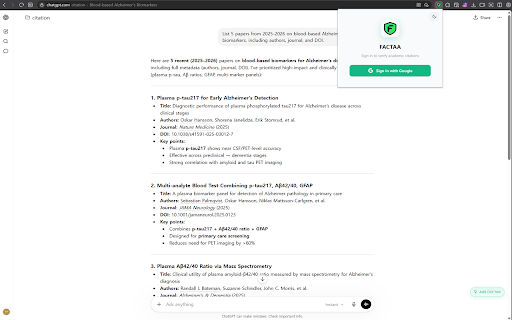
Real-time verify ChatGPT-generated research citations and detect hallucinated references before they enter your paper. Verify ChatGPT citations before they become a problem AI tools like ChatGPT are now widely used for literature exploration and drafting research content. However, they often generate citations that look convincing but do not actually exist. These hallucinated references can easily slip into drafts — and may lead to serious issues during peer review, including credibility loss or manuscript rejection. This Chrome extension helps you detect and verify AI-generated citations instantly, directly inside ChatGPT. What this extension does Instead of manually checking every reference, the extension analyzes citations generated by ChatGPT and evaluates their validity in real time. Each reference is marked using a simple and intuitive traffic-light system: 🟢 Verified — matches real publications and consistent metadata 🟡 Suspicious — incomplete, inconsistent, or partially matched information 🔴 Likely hallucinated — cannot be validated or may not exist This allows you to immediately identify problematic citations before using them in your work. How it works 1. Ask ChatGPT for research references 2. Click "Verify citations" in the extension 3. Instantly see verification results for each reference The extension integrates seamlessly into your workflow — no copy-pasting or external tools required. Key features Real-time citation verification: Analyze references directly within ChatGPT without leaving the page. Traffic-light evaluation system: Understand citation reliability at a glance using clear visual signals. Inline highlighting: Each reference is underlined and color-coded inside the ChatGPT response. Side panel overview: View all references in one place, along with their verification status. Direct source access: Click any reference to open the original source instantly. One-click citation copy: Easily copy verified references for use in your manuscript. Why this matters As AI becomes part of the research workflow, citation accuracy becomes harder to maintain. Hallucinated references are not just minor errors — they can: undermine the credibility of your work delay the review process lead to rejection in serious cases This tool helps you catch these issues early, before they become a problem. Who should use this This extension is designed for researchers who rely on AI tools in their workflow: Biomedical researchers Professors and principal investigators Postdoctoral researchers Graduate students Research scientists and analysts It is especially useful in fields where citation accuracy is critical, such as biomedical and life sciences. What makes this different Unlike generic reference tools, this extension focuses specifically on: AI-generated citation verification hallucination detection seamless integration inside ChatGPT No manual lookup. No switching between tools. No guesswork. Important limitations This tool assists with citation verification but does not replace expert judgment. Not all valid references may be detected Some results may require manual confirmation Users should always verify sources before submission Built for reliable AI-assisted research Use AI with confidence — without compromising academic integrity. Privacy & data handling This extension follows a privacy-first design: Only the text you explicitly select or submit is processed — the full conversation or page content is never read automatically. Submitted text is processed transiently in server memory and is not permanently stored in our databases. Only bibliographic metadata (DOI, PMID, title, authors) may be cached up to 30 days to improve re-verification speed. External AI providers (OpenAI) are invoked with training-opt-out settings applied. No personal data is sold, used for advertising, or shared with third parties beyond the service providers required to perform verification (Google OAuth, Crossref, NCBI, PubMed, arXiv, OpenAI). Supported platforms chat.openai.com chatgpt.com Support for additional platforms (Claude, Gemini, etc.) may be added in future versions with a separate review submission. Contact & support Privacy policy: https://factaa.ai/privacy Support email: [email protected]
Real-time verify AI-generated research citations from ChatGPT and Claude, and detect hallucinated references before they enter your paper.

Verify AI-generated citations before they become a problem
AI tools like ChatGPT and Claude are now widely used for literature exploration and drafting research content. However, they often generate citations that look convincing
but do not actually exist.
These hallucinated references can easily slip into drafts — and may lead to serious issues during peer review, including credibility loss or manuscript rejection.
This Chrome extension helps you detect and verify AI-generated citations instantly, directly inside ChatGPT and Claude.

What this extension does
Instead of manually checking every reference, the extension analyzes citations generated by ChatGPT and Claude and evaluates their validity in real time.
Each reference is marked using a simple and intuitive traffic-light system:
🟢 Verified — matches real publications and consistent metadata
🟡 Suspicious — incomplete, inconsistent, or partially matched information
🔴 Likely hallucinated — cannot be validated or may not exist
This allows you to immediately identify problematic citations before using them in your work.

How it works
1.    Ask ChatGPT or Claude for research references
2.    Click "Verify citations" in the extension
3.    Instantly see verification results for each reference
The extension integrates seamlessly into your workflow — no copy-pasting or external tools required.

Key features
Real-time citation verification: Analyze references directly within ChatGPT and Claude without leaving the page.
Traffic-light evaluation system: Understand citation reliability at a glance using clear visual signals.
Inline highlighting: Each reference is underlined and color-coded inside ChatGPT and Claude responses.
Side panel overview: View all references in one place, along with their verification status.
Direct source access: Click any reference to open the original source instantly.
One-click citation copy: Easily copy verified references for use in your manuscript.

Why this matters
As AI becomes part of the research workflow, citation accuracy becomes harder to maintain.
Hallucinated references are not just minor errors — they can:
    undermine the credibility of your work
    delay the review process
    lead to rejection in serious cases
This tool helps you catch these issues early, before they become a problem.

Who should use this
This extension is designed for researchers who rely on AI tools in their workflow:
    Biomedical researchers
    Professors and principal investigators
    Postdoctoral researchers
    Graduate students
    Research scientists and analysts
It is especially useful in fields where citation accuracy is critical, such as biomedical and life sciences.
 What makes this different
Unlike generic reference tools, this extension focuses specifically on:
    AI-generated citation verification
    hallucination detection
    seamless integration inside ChatGPT and Claude
No manual lookup. No switching between tools. No guesswork.
 Important limitations
This tool assists with citation verification but does not replace expert judgment.
    Not all valid references may be detected
    Some results may require manual confirmation
    Users should always verify sources before submission

Built for reliable AI-assisted research
Use AI with confidence — without compromising academic integrity.

Privacy & data handling
This extension follows a privacy-first design:
    Only the text you explicitly select or submit is processed — the full conversation or page content is never read automatically.
    Submitted text is processed transiently in server memory and is not permanently stored in our databases.
    Only bibliographic metadata (DOI, PMID, title, authors) may be cached up to 30 days to improve re-verification speed.
    External AI providers (OpenAI) are invoked with training-opt-out settings applied.
    No personal data is sold, used for advertising, or shared with third parties beyond the service providers required to perform verification (Google OAuth, OpenAI,
Crossref, NCBI PubMed E-utilities, arXiv, NANET National Assembly Library Search OpenAPI via data.go.kr, doi.org Content Negotiation).

Supported platforms
    chat.openai.com
    chatgpt.com
    claude.ai
Support for additional platforms (Gemini, etc.) may be added in future versions with a separate review submission.

Contact & support
    Privacy policy: https://factaa.ai/privacy
    Support email: [email protected]
Permissions & access
- Permissions
- storagesidePanelidentitycontextMenusscripting
- Host access
- https://api-citation.ryxen.cloud/*, https://citation.ryxen.cloud/*, https://*.ryxen.cloud/*, https://accounts.google.com/*, https://www.googleapis.com/*
Screenshots


About
Real-time verify AI-generated research citations from ChatGPT and Claude, and detect hallucinated references before they enter your paper.

Verify AI-generated citations before they become a problem
AI tools like ChatGPT and Claude are now widely used for literature exploration and drafting research content. However, they often generate citations that look convincing
but do not actually exist.
These hallucinated references can easily slip into drafts — and may lead to serious issues during peer review, including credibility loss or manuscript rejection.
This Chrome extension helps you detect and verify AI-generated citations instantly, directly inside ChatGPT and Claude.

What this extension does
Instead of manually checking every reference, the extension analyzes citations generated by ChatGPT and Claude and evaluates their validity in real time.
Each reference is marked using a simple and intuitive traffic-light system:
🟢 Verified — matches real publications and consistent metadata
🟡 Suspicious — incomplete, inconsistent, or partially matched information
🔴 Likely hallucinated — cannot be validated or may not exist
This allows you to immediately identify problematic citations before using them in your work.

How it works
1.    Ask ChatGPT or Claude for research references
2.    Click "Verify citations" in the extension
3.    Instantly see verification results for each reference
The extension integrates seamlessly into your workflow — no copy-pasting or external tools required.

Key features
Real-time citation verification: Analyze references directly within ChatGPT and Claude without leaving the page.
Traffic-light evaluation system: Understand citation reliability at a glance using clear visual signals.
Inline highlighting: Each reference is underlined and color-coded inside ChatGPT and Claude responses.
Side panel overview: View all references in one place, along with their verification status.
Direct source access: Click any reference to open the original source instantly.
One-click citation copy: Easily copy verified references for use in your manuscript.

Why this matters
As AI becomes part of the research workflow, citation accuracy becomes harder to maintain.
Hallucinated references are not just minor errors — they can:
    undermine the credibility of your work
    delay the review process
    lead to rejection in serious cases
This tool helps you catch these issues early, before they become a problem.

Who should use this
This extension is designed for researchers who rely on AI tools in their workflow:
    Biomedical researchers
    Professors and principal investigators
    Postdoctoral researchers
    Graduate students
    Research scientists and analysts
It is especially useful in fields where citation accuracy is critical, such as biomedical and life sciences.
 What makes this different
Unlike generic reference tools, this extension focuses specifically on:
    AI-generated citation verification
    hallucination detection
    seamless integration inside ChatGPT and Claude
No manual lookup. No switching between tools. No guesswork.
 Important limitations
This tool assists with citation verification but does not replace expert judgment.
    Not all valid references may be detected
    Some results may require manual confirmation
    Users should always verify sources before submission

Built for reliable AI-assisted research
Use AI with confidence — without compromising academic integrity.

Privacy & data handling
This extension follows a privacy-first design:
    Only the text you explicitly select or submit is processed — the full conversation or page content is never read automatically.
    Submitted text is processed transiently in server memory and is not permanently stored in our databases.
    Only bibliographic metadata (DOI, PMID, title, authors) may be cached up to 30 days to improve re-verification speed.
    External AI providers (OpenAI) are invoked with training-opt-out settings applied.
    No personal data is sold, used for advertising, or shared with third parties beyond the service providers required to perform verification (Google OAuth, OpenAI,
Crossref, NCBI PubMed E-utilities, arXiv, NANET National Assembly Library Search OpenAPI via data.go.kr, doi.org Content Negotiation).

Supported platforms
    chat.openai.com
    chatgpt.com
    claude.ai
Support for additional platforms (Gemini, etc.) may be added in future versions with a separate review submission.

Contact & support
    Privacy policy: https://factaa.ai/privacy
    Support email: [email protected]
Technical
- Version
- 1.1.0
- Manifest
- V3
- Size
- 171KiB
- Min Chrome
- 88
- Languages
- 1
- Featured
- No
Metadata
- ID
- hdbimkefkfbebffchgpgfkpkglmmkpab
- Developer ID
- u294a9bba5b14d6817e85f4053cf16cd3
- Developer Email
- [email protected]
- Created
- Apr 22, 2026
- Last Updated (Store)
- May 26, 2026
- Last Scraped
- Jun 11, 2026
- Website
- factaa.ai
- Support URL
- —
- Privacy Policy
- https://factaa.ai/privacy
Data sourced from the Chrome Web Store · last verified Jun 11, 2026.