
Secret Pusher
Generate passwords and create encrypted one-time Secret Pusher links from Chrome.
As of July 2026, Secret Pusher has — users in the Productivity category.
Usersno change0%
—
—
Ratingno change0%
—
— reviews
Reviewsno change0%
—
Version
1.0.0
Manifest V3
History
1 snapshotsTracking since Jul 10, 2026.
Not enough history yet for this metric — the chart fills in as we collect more snapshots.
View as table
| Date | Users | Rating | Reviews | Version |
|---|---|---|---|---|
| Jul 10, 2026 | — | — | — | 1.0.0 |
| Now | — | — | — | 1.0.0 |
Permissions & access
- Permissions
- sidePanelcontextMenusstorage
- Host access
- https://secretpusher.com/*
Screenshots


About
Secret Pusher helps you share sensitive information without pasting raw secrets into email, chat, tickets, or documents.

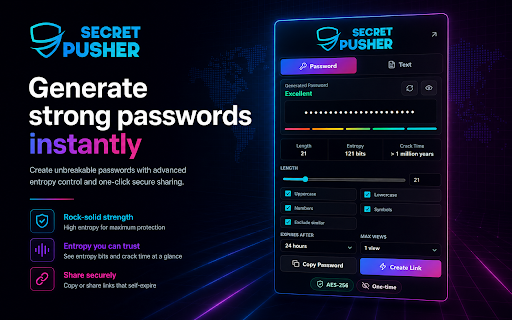
Use the Secret Pusher Chrome extension to create encrypted one-time links directly from Chrome. Generate a strong password, create a secure share link, copy both when needed, or paste any private text and turn it into a temporary secret link in seconds.

It is built for quick, everyday security workflows:

- Send a password securely
- Share an API key or access token
- Deliver login credentials to a client or teammate
- Send a private note without leaving it in chat history
- Create a self-destructing link for temporary secret access
- Share selected text from a web page using the right-click menu

The extension opens in Chrome's Side Panel, so it stays available beside your current tab without covering the page you are working on.

Key features:

- Password generator for strong random passwords
- Copy password and copy secret link workflow
- Text secret sharing for passwords, tokens, keys, notes, and credentials
- One-time links with max-view controls
- Expiring links with time-based cleanup
- Local browser encryption before the secret is sent
- No login required for the extension
- Right-click selected text to start a new secret
- Clean side panel UI built for fast use

Security and privacy:

Secret Pusher encrypts your secret in the browser before creating the share link. The decryption key is kept in the URL fragment, which means it is not sent to the Secret Pusher API as part of the encrypted payload request.

The extension does not store your generated passwords, pasted secrets, encrypted payloads, or created links in durable Chrome storage. It is designed for temporary secret delivery, not long-term password management.

Who is Secret Pusher for?

Secret Pusher is useful for developers, DevOps engineers, IT teams, support teams, agencies, freelancers, and anyone who needs a safer way to send credentials or private text.

Instead of sending a password, API token, or sensitive note directly through Slack, email, Teams, Discord, support tickets, or project-management tools, create a one-time encrypted link and share that link instead.

What is Secret Pusher?

Secret Pusher is a secure secret-sharing service for temporary delivery of sensitive information. It creates encrypted, expiring, burn-after-read links for private text, passwords, credentials, tokens, and other secrets.

The Chrome extension brings the core Secret Pusher workflow into your browser so you can create secure links faster, without switching tabs or signing in.

Common use cases:

- Send a password to a coworker
- Share credentials with a client
- Send an API key to a developer
- Deliver a temporary access token
- Share a private note that should expire
- Replace plain-text secrets in email or chat
- Generate a strong password and share it safely

Secret Pusher is free to use for this extension workflow and does not require authentication.
Technical
- Version
- 1.0.0
- Manifest
- V3
- Size
- 373KiB
- Min Chrome
- 116
- Languages
- 1
- Featured
- No
Metadata
- ID
- fkhhdbkcjcokpafpjeaebjhmolcoigkb
- Developer ID
- ue19347456dc91b220f562bac60eec0af
- Developer Email
- [email protected]
- Created
- Jul 9, 2026
- Last Updated (Store)
- Jul 9, 2026
- Last Scraped
- Jul 10, 2026
- Website
- secretpusher.com
- Support URL
- —
- Privacy Policy
- https://secretpusher.com/privacy-policy
Data sourced from the Chrome Web Store · last verified Jul 10, 2026.